REVIEW · CITY TOURS
Amsterdam: Guided Red Light District and City Walking Tour
Book on Viator →Operated by Trigger Tours · Bookable on Viator
Amsterdam’s Red Light District has secrets.
This guided walking tour makes the Red Light District easier to understand by pairing what you see on the street with how Amsterdam’s laws, history, and buildings shaped the area. I like that the walk also ties into older Amsterdam landmarks in the surrounding neighborhoods, so you’re not just staring at shopfront windows.
I really love the way the guides tell the stories behind specific places, with names like Ben, Pedro, Max, and Ari showing up in the guide lineup and (based on what people highlight) bringing the area to life with humor and clear context. I also appreciate the pace and format: about 2 hours on foot with a small maximum group size, which helps you ask questions without feeling rushed.
One drawback to consider: it’s not recommended for travelers with limited mobility, and the subject matter (sex work and related businesses) can feel uncomfortable if you’re looking for a totally light, hands-off sightseeing vibe.
In This Review
- Key things you’ll notice on this Red Light District walk
- Entering The Red Light District from a streets-and-stories angle
- The meeting point and the 2-hour walking format that keeps it manageable
- The Dam and Amsterdam’s wooden-pole secret under your feet
- Old Town context: why the streets feel older here
- Pub The Ape (Int Aepjen): a 1540 wooden survivor
- Waag: the city gate turned into a trade center
- The smallest house and the VOC connection
- The Condomerie: sex-themed commerce meeting a clear modern marker
- A late start can make the visuals better
- Price and value: what $35.44 buys you
- So, what’s the real point of the history stops?
- Who this tour suits best (and who might prefer something else)
- Should you book this Amsterdam Red Light District walking tour?
- FAQ
- How long is the Amsterdam Red Light District and city walking tour?
- What language is the tour offered in?
- How many people are in the group?
- What’s included in the price?
- Is food or drinks included?
- Can I cancel for a full refund?
Key things you’ll notice on this Red Light District walk
- A tight 2-hour route that keeps you moving through the core streets rather than hopping across town
- Old Town context as you pass older structures tied to gates, trade, and Amsterdam’s unusual building foundations
- Iconic stops with real details, like the Waag and the long-remaining wooden Pub The Ape
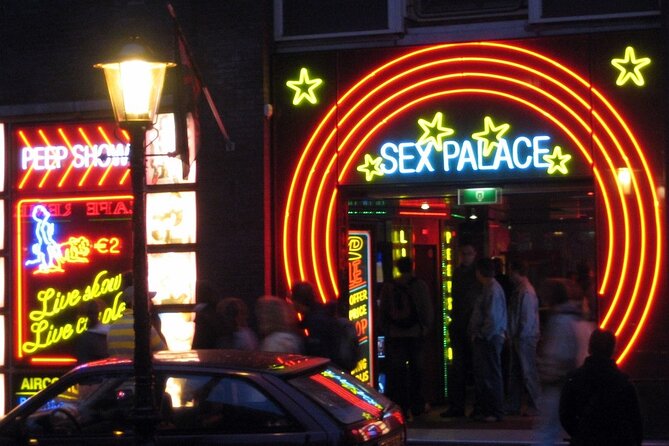
- A mix of history and modern reality, including Amsterdam’s legal and commercial setup around sex work
- A small group (up to 15), which usually makes Q&A more practical
- No food included, so you’ll want to plan a drink or snack before or after
Entering The Red Light District from a streets-and-stories angle
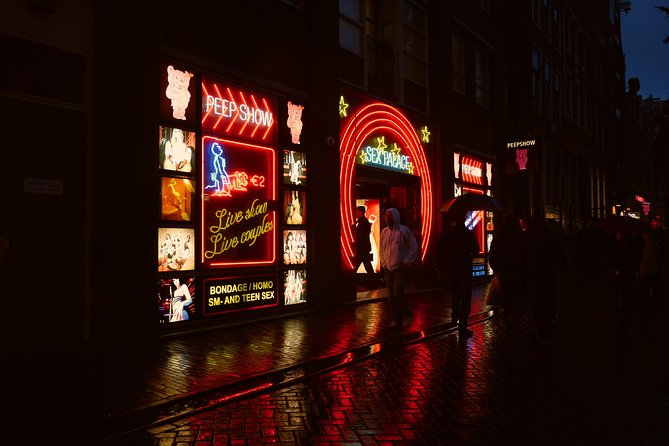
This tour is built for people who want to go beyond what the neighborhood looks like from across the street. You’ll walk at human speed through narrow lanes where Amsterdam’s architecture, canals, and old building traditions are all part of the story. The guide doesn’t treat the area like a circus. Instead, you get a running explanation of how the district formed, how it operates today, and how the city thinks about it.
What I find most useful is the way this approach changes your brain while you walk. If you come in with questions like Why here? How did it start? How does Amsterdam manage it? you’ll get answers in plain language while you’re actually standing near the places involved. It’s a lot easier to remember details when they’re anchored to real corners and landmarks instead of facts floating in your head.
And yes, the neighborhood is still the neighborhood. You’ll see what you came to see—windows and the busy energy that comes with them. But the “why” behind it matters, and that’s where the guide’s framing helps.
You can also read our reviews of more walking tours in Amsterdam



The meeting point and the 2-hour walking format that keeps it manageable
The walk begins at Geldersekade 2 (1012 BH Amsterdam) and ends back near the same area. The whole experience is about 2 hours, which is a sweet spot for this kind of tour. Long walks can turn into pure survival mode. Short ones can leave you feeling like you only got the highlight reel. Two hours tends to land where you can absorb a lot without your feet giving up.
You’ll be in a group, but the max is 15 travelers, so it doesn’t feel like a school trip. The tour is offered in English, and you’ll get a mobile ticket. Service animals are allowed, which is good to know if you rely on one.
One practical note: because this is a walking tour through tight streets, and because it’s specifically not recommended for limited mobility, you’ll want to treat it like a “comfortable walking shoes” outing, not a sit-and-stare city stroll.
The Dam and Amsterdam’s wooden-pole secret under your feet
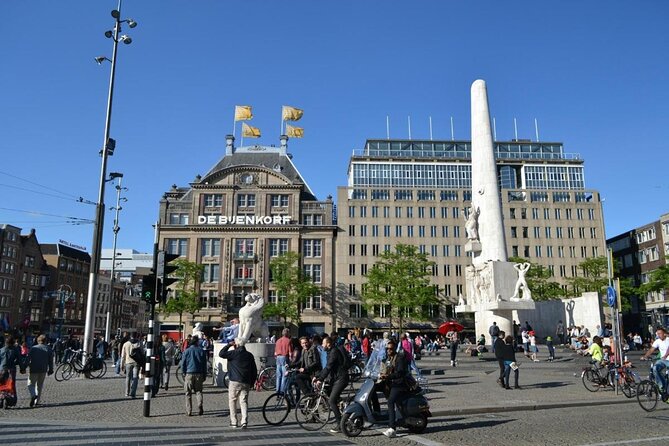
A big part of what makes Amsterdam feel like Amsterdam is hidden below street level. When you stop near the Dam, you’re not just seeing a landmark—you’re getting a quick lesson in why the city had to build the way it did.
Amsterdam’s soil has a thick layer of fen and clay, plus water and softer layers underneath. The city’s older houses were built on wooden foundation piles driven deep into the clay and peat until they reached a solid sand layer. That detail matters because it explains the city’s building logic and why Amsterdam’s historic structures look the way they do.
This is one of those moments where a “history” stop actually improves your sightseeing. After hearing about the wooden foundations, you tend to notice more: the age of the structures, the way buildings cluster in older neighborhoods, and how the city’s engineering quietly supports the romantic postcard look.
Old Town context: why the streets feel older here
From the Dam area, you shift into an understanding of how the district fits into the Old Town fabric. This is the oldest part of the city, which is why you’ll hear a lot about historical layers as you move.
Even if your main reason for booking is the Red Light District, this context changes how you experience the walk. Instead of treating the neighborhood like a standalone attraction, you see it as part of a much older city plan—one that grew around trade, shipping, and the practical needs of merchants and travelers.
Pub The Ape (Int Aepjen): a 1540 wooden survivor
One of the standout stops is Pub The Ape, also known as Int Aepjen. It’s built around 1540, and it’s described as one of the last remaining wooden buildings in Amsterdam.
Why that’s fascinating: Amsterdam had major fires in the past. After the big fire in 1452, authorities made stronger building rules, pushing more construction toward brick facades. So when you hear about Int Aepjen as a remaining wooden structure, it becomes a living reminder that Amsterdam’s “today” rests on older decisions, risks, and repairs.
If you’re the type who likes architecture details, this stop is worth leaning into. You can’t control the fact that the Red Light District is the main draw, but you can control whether you treat the whole tour like one long look at windows or like a mix of people, places, and surviving buildings.
You can also read our reviews of more guided tours in Amsterdam




Waag: the city gate turned into a trade center
Next comes the Waag—a building that used to be part of Amsterdam’s defensive setup. It was built around the 1400s and is described as the second oldest building of Amsterdam.
You’ll also hear how it later served the city as a guild and crafts area, with craftspeople’s organizations tied to the Waag and the square around it. In other words: this wasn’t just a pretty old building. It played a functional role as Amsterdam grew from a defensive city into a trade city.
This stop works well because it links the city’s physical design to its economic history. And it’s a good reminder that neighborhoods like this one aren’t “new” in the way we often assume—they’re tied to older waves of commerce and port activity.
The smallest house and the VOC connection
Another cool stop is the smallest house of Amsterdam, built around the 1700s. It began as storage for the VOC trading company, and later people lived in the house for a very long time.
This is the kind of detail that makes a walking tour feel smarter instead of just longer. A tiny building forced into a bigger city context tells you something about how space worked in the past. And the VOC link keeps the story grounded in Amsterdam’s trading identity, not just local folklore.
If you’re traveling with kids, this might be the stop that sparks questions fast. If you’re traveling solo, it’s the kind of fact that stays with you later because it feels oddly specific—small house, long life, big trade connection.
The Condomerie: sex-themed commerce meeting a clear modern marker
Then you’ll reach the Condomerie, described as the world’s first condom shop specializing in condoms since 1987. It’s also noted that you can get customized sizes and special condom types.
I’ll be straight with you: this isn’t there to be quirky for the sake of it. It’s a real marker of the modern services and rules that exist around the district. Amsterdam’s approach to sex work is often discussed in terms of regulation and public order. A stop like this gives you a tangible example of how businesses evolved beyond older patterns.
You don’t need to be shocked to appreciate it. You just need to be willing to look at the district as part of a regulated city economy—not just a spectacle.
A late start can make the visuals better
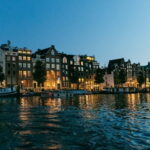
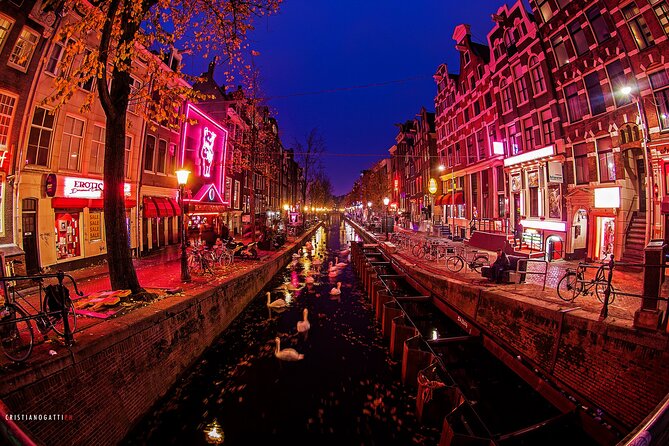
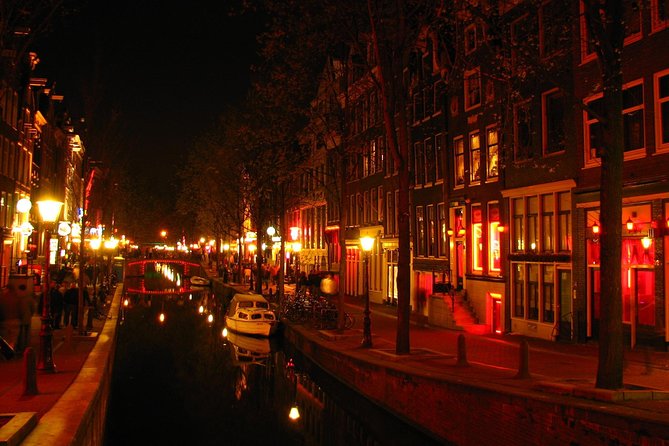
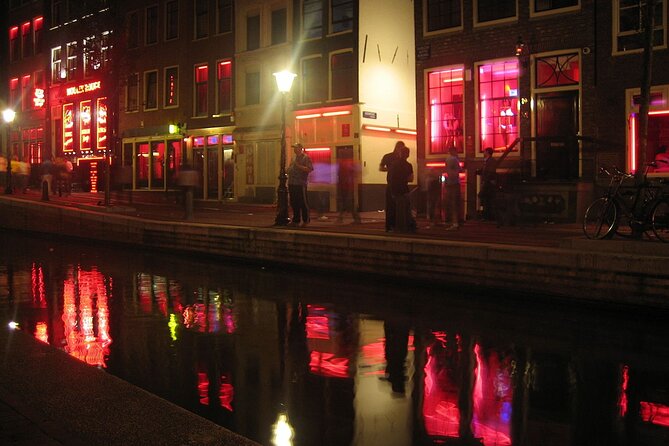
Tour timing can change how the neighborhood feels. One highlight from people who took it late in the day: the 8 pm timing in late summer meant there was still plenty of light on the streets, plus the bridge lights looked spectacular later.
You’re not booking a photography tour, but this matters. When the light shifts, canals, street reflections, and nearby bridge views can make the city feel extra cinematic. If your schedule allows it, I’d pick the later start times when you can.
Price and value: what $35.44 buys you
At $35.44 per person for roughly two hours, the value comes down to guide quality and how much context you want. You get a licensed guide plus a local guide, and the tour is capped at 15 people. For an Amsterdam experience that includes sensitive, easy-to-misread streets, a structured explanation can be the difference between “I walked past things” and “I understand what I just saw.”
This isn’t a budget “walk around and hope” situation. It’s also not trying to sell you anything beyond the sightseeing itself. There’s no food included, so you’re not paying for a meal you might not want. In that sense, the price is mostly paying for the interpretation, the local street knowledge, and the way the stops connect to the city’s legal, architectural, and trade history.
So, what’s the real point of the history stops?
The non-window stops—Dam foundations, Waag, the smallest house, and Pub The Ape—aren’t random diversions. They’re the glue that makes the Red Light District intelligible as part of Amsterdam’s story.
Here’s how I’d think about it:
- The Dam and wooden foundation explain the city’s building reality. That makes the architecture feel less like decoration and more like engineering.
- Waag connects old city gates and guild life to trade and crafts—Amsterdam as a working port city.
- The smallest house and VOC tie the compact living and commerce story together.
- Pub The Ape shows how older building rules shaped what still survives.
- The Condomerie gives you a modern marker of how services evolved, right where the district operates.
That mix helps you avoid a common mistake: treating the Red Light District as if it’s only about the storefronts. It’s also about a city’s systems—space, law, commerce, and building rules.
Who this tour suits best (and who might prefer something else)
This fits best if you want:
- a structured walk through a sensitive area with clear context
- architecture and old Amsterdam history tied directly to what you’re seeing
- a question-friendly guide style (many guides on the roster are praised for clarity and storytelling)
It’s less ideal if:
- you have limited mobility (it’s explicitly not recommended)
- you want a purely upbeat, low-pressure sightseeing day
- you’d be distressed by adult-themed streets and businesses, even when explained in a factual way
Also, keep it practical: no food or drinks are included, so plan a snack or something warm outside the tour window if weather is chilly.
Should you book this Amsterdam Red Light District walking tour?
If you’re curious, respectful, and you like your city with context, I think this is a smart booking. Two hours gives you a fast but meaningful sense of how Amsterdam’s Red Light District fits into older Old Town space and how the city’s systems shaped what you see now.
I’d only hesitate if your top priority is comfort over clarity. The subject is adult, and the streets are real-life busy. If you need quiet, this may not be your match. But if you want to understand the district instead of just passing through it, this tour is a good way to get your bearings fast.
FAQ
How long is the Amsterdam Red Light District and city walking tour?
It lasts about 2 hours.
What language is the tour offered in?
The tour is offered in English.
How many people are in the group?
The tour has a maximum of 15 travelers.
What’s included in the price?
You get a licensed guide and a local guide.
Is food or drinks included?
No. Food and drinks are not included.
Can I cancel for a full refund?
Yes. Free cancellation is available up to 24 hours in advance for a full refund.
If you want, tell me your travel month and whether you prefer an earlier or later start time, and I’ll suggest the best window for your schedule and comfort level.