REVIEW · MUSEUMS
Van Gogh Museum Private Tour
Book on Viator →Operated by 360 Amsterdam Tours · Bookable on Viator
Van Gogh hits you faster when a guide steers the day. This private tour pairs a private guide with a whisper system, so you can hear the story clearly as you move through the museum. I like that the admission is built in, so you’re not juggling ticket hassles mid-museum.
I also love how the route feels like a life timeline, not a random grab bag of paintings. You move from self-portraits to Paris, then on to Arles, Saint-Rémy, and the Auvers room—so the work starts to connect.
One thing to consider: you’re generally not allowed to stay in the museum after the tour unless you’re traveling light. If you arrive with big bags, plan to exit when the tour ends.
In This Review
- Key things to know before you go
- Van Gogh Museum Private Tour: why 2 hours feels exactly right
- Meeting up near Cobra Café, then wrapping at Museumplein
- Start in the right place: self-portraits that set the tone
- First Floor Foyer: Millet and Breton, plus the Potato Eaters world
- Paris years, 1886–1888: felt hats, absinthe, and real social scenes
- Arles and the South of France, 1888: sunflowers to the Yellow House
- Level 3: Saint-Rémy-de-Provence and the paintings that feel like states of mind
- The Auvers room: where the story tightens
- What the best guides actually do (and why reviews keep naming them)
- Price and value: $263.20 per person, ticket included
- Who this tour suits best
- Should you book this private Van Gogh Museum tour?
- FAQ
- FAQ
- How long is the Van Gogh Museum private tour?
- Where does the tour start?
- Where does the tour end?
- Is admission to the Van Gogh Museum included?
- Is the tour offered in English?
- Is there a whisper system?
- Do I get a private guide?
- Are food and drinks included?
- Can I stay in the museum after the tour ends?
- Who can join this tour?
- What is the cancellation policy?
Key things to know before you go
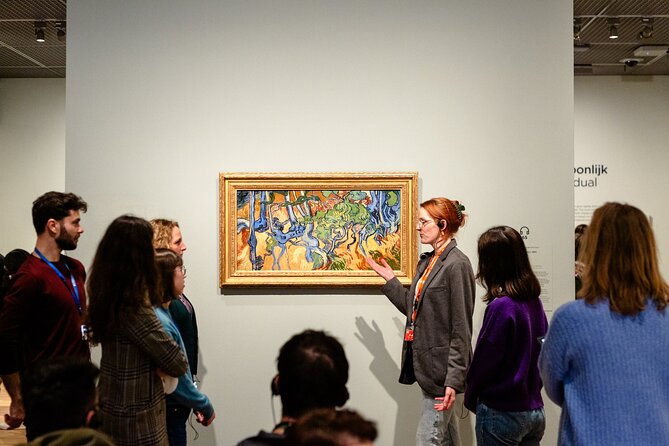
- Whisper-system audio helps you hear your guide without craning your neck in busy galleries.
- A timeline route through the key eras takes you from Paris (1886–1888) to Arles (1888), then Saint-Rémy and Auvers.
- Short, paced stops keep the tour moving while still leaving room for questions.
- Guides make it fun, not just factual: reviews highlight Sylvia’s interactive energy, Giulia’s easy pacing, and Kiran’s patience.
- Admission tickets are included for each section you enter, so your time stays focused on art.
Van Gogh Museum Private Tour: why 2 hours feels exactly right
The Van Gogh Museum can be a lot. It’s not hard to get lost between rooms, labels, and crowds. This is where the private format earns its keep. Instead of spending your brainpower on logistics, you spend it on seeing. Your guide keeps the flow tight and explains what to look for, when to look, and why those choices mattered to Van Gogh.
The whisper system is especially useful in a museum setting. You don’t have to keep stepping aside or competing with the noise level. That means more looking time, less searching for where to stand, and fewer moments when you wish you could hear the explanation better.
This tour is also a smart “midday reset.” It’s long enough to gain real understanding, but short enough that you can still do a bigger sightseeing loop after. That balance matters in Amsterdam, where you can burn hours fast just getting from one great stop to another.
You can also read our reviews of more private tours in Amsterdam

Meeting up near Cobra Café, then wrapping at Museumplein
You meet at Cobra Café, Hobbemastraat 18, 1071 ZB Amsterdam. It’s in a practical part of town for transit, and you’ll be able to sync up with your day without a complicated pre-plan.
The tour ends at Museumplein 6, 1071 DJ Amsterdam. That’s helpful because you’re not stuck figuring out your next move right after the museum visit.
Now the key practical note: after the visit, you’re not allowed to stay in the museum unless you’re traveling lightly (the info specifically mentions not having thick winter-jackets, suitcases, large bags, and liquids). If you go light with a small jacket and small handbag, you can stay until closing. If you hate rushing, pack like you want extra time.
Start in the right place: self-portraits that set the tone
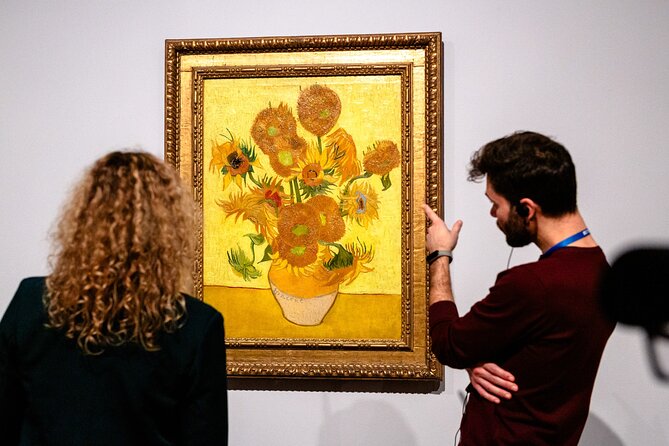
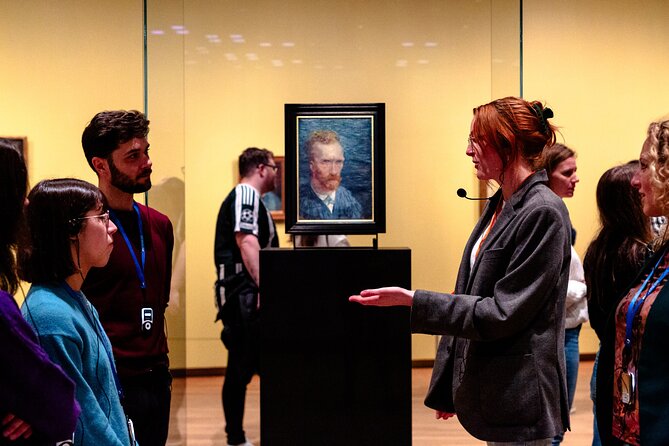
You begin with Van Gogh’s self-portraits, around 20 minutes with admission included. This opening is more than a quick introduction. It sets up how you’ll read everything else.
Here’s why I think this works: self-portraits teach you to look at change over time—mood, technique, and even how he frames himself. After you’ve seen that, the later work feels less like isolated masterpieces and more like chapters of the same personal project.
At this stage, the guide’s job is gold: you’ll get help noticing brushwork choices and how his expression and composition shift. Without guidance, it’s easy to admire the pictures and still miss the pattern. With a guide, the pattern becomes obvious fast.
First Floor Foyer: Millet and Breton, plus the Potato Eaters world
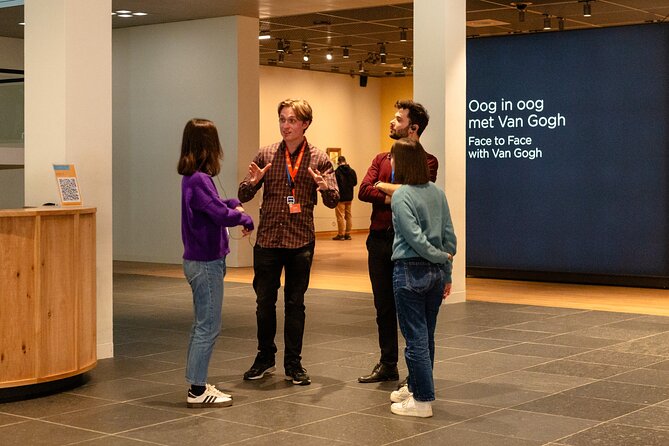
Next you step into the First Floor Foyer for another 20 minutes, still with admission included. This section matters because it puts Van Gogh in conversation with other artists and with everyday subjects.
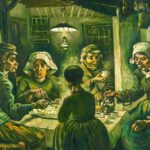
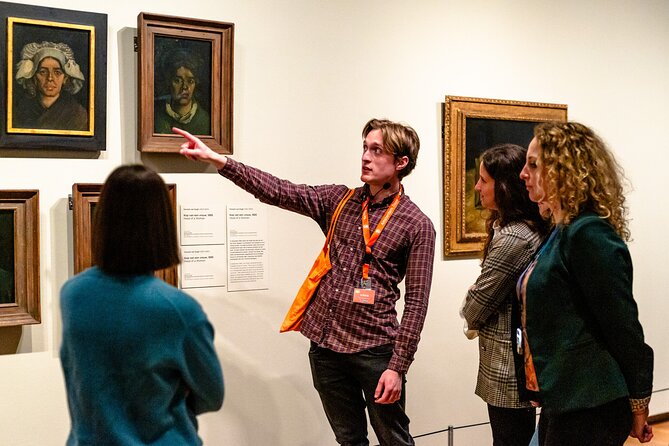
You spend time with works by Millet and Jules Breton, including paintings like Woman Lifting Potatoes and The Potato Eaters. There’s also a “wall of portraits” featuring Head of a Peasant Woman.
This is a subtle but important angle. Van Gogh is famous for his bold colors and big emotional lines, but his early choices were also shaped by interest in ordinary people and rural life. When the guide connects those themes to what you’ll see later—especially how subject matter and style evolve—it makes the museum feel coherent instead of scattered.
A quick consideration: because this area is a foyer and circulation space, it can feel busier than you’d expect. The whisper system helps, and your guide’s pacing keeps you from getting stuck behind a cluster of people.
Paris years, 1886–1888: felt hats, absinthe, and real social scenes
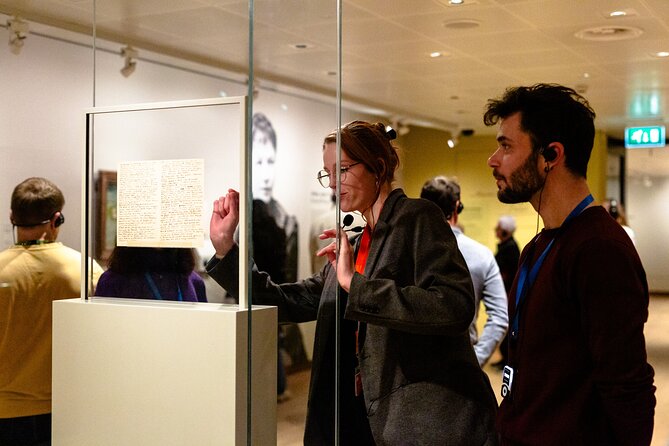
Then the tour shifts to Vincent’s move to Paris between 1886 and 1888, again around 20 minutes with admission included. This part is packed with recognizable titles and the kind of details that reward close looking.
You’ll see Self Portrait with Felt Hat, Still Life with Absinthe, and In the Café: Agostina Segatori in Le Tambourin. There’s also Garden with Courting Couples.
What I love about this era in a guided setting is the way it turns the paintings into lived moments. A still life like absinthe is easy to treat like decor when you’re on your own. A guide can point out why he would be drawn to that subject—how it fits into what he’s learning, how he’s observing, and how his world is changing.
For the café scene, the benefit is even clearer. You get help sorting through expressions and composition, instead of just noticing the obvious figures. Same with the garden scene: you’ll be guided to see how relationships and setting blend into his story.
You can also read our reviews of more museum experiences in Amsterdam





Arles and the South of France, 1888: sunflowers to the Yellow House
After Paris, you head into the Arles and the South of France section where Vincent moves in 1888. This segment also runs about 20 minutes with admission included.
Highlights include Sunflowers, Almond Blossoms, and The Bedroom. You’ll also see Japanese paintings (copies from prints) and The Yellow House.
This is one of the most exciting parts for people who already feel they know Van Gogh’s “look.” Sunflowers are iconic, sure—but the guide can help you notice how the style is doing work: how color intensity supports mood, and how composition signals what he’s chasing emotionally.
The Japanese paintings deserve a special mention. Even when you’re not an art-history nerd, it’s a fascinating entry point into how artists borrow. Seeing those copies in context helps you understand that Van Gogh wasn’t just inventing from scratch; he was absorbing influences and translating them into his own voice.
Level 3: Saint-Rémy-de-Provence and the paintings that feel like states of mind
On Level 3, the tour moves to Saint-Rémy-de-Provence, with another 20 minutes and admission included. Here you’ll see Almond Blossoms, Wheatfield with a Reaper, Iris, and Pieta (After Delacroix).
This is where the guided format really pays off. The titles alone don’t always tell you what to focus on. A guide can help you read the emotional tone—how the painting communicates tension, recovery, or reflection without turning it into a lecture.
- With Wheatfield with a Reaper, you’re taught what to watch for in the sense of motion and space.
- With Iris, you get help noticing how color and form do more than decorate.
- With Pieta (After Delacroix), the “after” matters. The guide can point you toward how Van Gogh interprets an existing subject rather than copying it like a photocopy.
A practical note: Level 3 means stairs and more walking. It’s not extreme, but it is a museum. If you’re visiting in warm weather or with mobility limits, it helps to wear comfortable shoes and keep your pace steady.
The Auvers room: where the story tightens
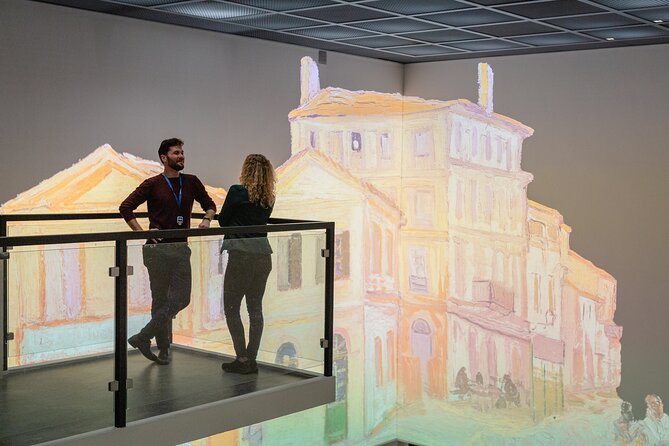
Finally, you reach the Auvers Room (still on Level 3), with about 15 minutes and admission included. The focus here is tighter: Tree Roots and Wheatfield with Crows.
This last segment is short, but it’s chosen well. These works tend to land with a different emotional weight, and the guided explanation helps you understand why they feel urgent. When you see them right after Saint-Rémy, the shift doesn’t feel random—it feels like progression.
If you’re the type who wants to stand still and stare, you might feel the time is quick. That’s the trade-off for a 2-hour tour. The plus is that you’re leaving with a clearer map of Van Gogh’s phases instead of just a stack of impressions.
What the best guides actually do (and why reviews keep naming them)
The reviews are consistent on the same theme: the guide makes the difference.
- Sylvia is praised for being interactive and fun, with a vibe that keeps you engaged rather than drifting through rooms.
- Giulia is described as keeping a perfect pace, with explanations that let you ask questions.
- Kiran stands out for clarity and patience, plus the way he kept a small group moving without shutting down questions.
That pattern tells you what to expect from a good guide: they don’t just tell facts. They guide your attention. They help you connect paintings to the life around them—Paris to Arles to Saint-Rémy to Auvers—so you’re not just collecting titles.
Also, the whisper system shows up in the review themes as working well. That’s a small detail, but it’s a big quality-of-life thing. When you can hear the guide easily, you can focus on the art instead of the logistics.
Price and value: $263.20 per person, ticket included
At $263.20 per person for a roughly 2-hour private tour, the value comes down to what you want from the museum.
If you’re okay wandering and reading on your own, you may not feel the cost is justified. The museum already has labels, audio options, and a built-in flow.
But if you want your time to feel useful—like you’re getting the right explanations at the right moments—this tour is built for that. Admission is included, and you get a guide who’s tailoring your walk through the permanent collection in a guided language format. The whisper system also reduces the chances of a frustrating, half-heard explanation.
One more angle: this is a private tour where only your group participates. If you’re traveling as a pair or small group, the cost often feels more manageable than if you’re going solo (because you spread the “private” part across people).
Who this tour suits best
This is a good fit if:
- you want a fast, organized Van Gogh story without feeling rushed by your own planning
- you’re visiting the museum as part of a bigger Amsterdam day and need a tight timeline
- you like asking questions and hearing how your guide interprets choices in the paintings
- you want the comfort of a guide working with a whisper system instead of competing with the crowd
It may be less ideal if:
- you want to spend long stretches staring quietly without moving
- you plan to carry bulky items into the museum and would rather avoid the post-tour staying limits
Should you book this private Van Gogh Museum tour?
If you’re choosing between doing Van Gogh on your own and paying for help, I’d lean toward booking this private tour if you care about understanding the paintings as a connected story. The format is efficient. You’ll see major works across major periods, and the guide’s pacing keeps you from wasting time.
I’d pass only if you already know exactly what you want to see and you’re happy reading labels at your own speed. For most people, though, the combination of private guidance, included admission, and a clear life timeline makes the price feel like you bought time and clarity—not just access.
FAQ
FAQ
How long is the Van Gogh Museum private tour?
It’s about 2 hours (approx.).
Where does the tour start?
The meeting point is Cobra Café, Hobbemastraat 18, 1071 ZB Amsterdam.
Where does the tour end?
It ends at Museumplein 6, 1071 DJ Amsterdam.
Is admission to the Van Gogh Museum included?
Yes. Admission tickets are included for the museum entry during the tour stops.
Is the tour offered in English?
The tour is listed as offered in English.
Is there a whisper system?
Yes. The tour includes a whisper system.
Do I get a private guide?
Yes. It’s a private tour with a guide for your group only.
Are food and drinks included?
No. Food & beverages are not included.
Can I stay in the museum after the tour ends?
You’re generally not allowed to stay unless you visit lightly. The details mention you can stay until closing time if you have just a small jacket and small handbag, and you don’t have thick winter-jackets, suitcases, large bags, or liquids.
Who can join this tour?
It’s only available for adults 18 years or older.
What is the cancellation policy?
You can cancel for a full refund if you cancel up to 24 hours in advance. Free cancellation is offered.