REVIEW · CYCLING TOURS
Amsterdam in World War Two Cycle Tour
Book on Viator →Operated by Slagveldreizen.nl · Bookable on Viator
A city can change in a few blocks and a few years. This Amsterdam WWII bike tour takes you through Amsterdam South on streets most cars never use, while showing WWII photos matched to today’s locations. I especially love how the route feels like a real neighborhood walk-by, not a scripted bus stop. I also like that the group is tiny, with a max of six riders, so the guide can answer questions without herding you like luggage.
The big reason I think this works is the way history is paired with what you can actually see. At several stops, you’re looking at the same corners where arrests, offices, and resistance activity happened—then you’re shown period images that make the past click. My other favorite part is the guide team, including Rudy (and Peter on some departures), who clearly knows these streets as a lived-in story, not a textbook chapter.
One thing to consider: you’re cycling. If you’re not comfortable on Amsterdam bike paths for about 2.5 to a bit over 3 hours, you’ll feel it—especially because the tour packs in many locations in a short time.
In This Review
- Key reasons this WWII bike tour is worth your attention
- Why cycling makes WWII Amsterdam feel different than museums
- The route: from Daniël Willinkplein to May 7, 1945
- The opening ride at Victorieplein and the June 20, 1943 raid
- Merwedeplein: the Frank family home and the Anne Frank diary story
- Tilex Bar history at Waalstraat 48 (now Café Blek)
- Cornelis Troostplein and the PBA barracks connection
- Museumplein: German offices, bunkers, and Flak batteries
- Roelof Hartplein: coffee, restroom, and a practical reset
- Roelof Hartstraat: resistance photo development
- Beethovenstraat / Apollolaan: execution and retaliation in October 1944
- Memlingstraat / Rubensstraat: two key Nazi oppression offices
- Olympiaplein / Parnassusweg: registration with help from Westerbork camp police
- Valeriusplein / Amsterdam Lyceum and the Luftwaffe HQ
- Queen Emma’s statue and small defiance in 1940
- Ending with May 7, 1945: surrender tension and shootings
- WWII photos: the tour’s secret weapon
- The feel of the ride: safety, pacing, and car-free pockets
- Coffee break timing: why the Roelof Hart stop is smart
- Price and value for a focused 2.5–3 hour history ride
- Who should book this bike tour (and who might skip it)
- Quick practical checklist for your day
- Should you book this Amsterdam WWII cycling tour?
- FAQ
- How long is the Amsterdam in World War Two cycle tour?
- Where do I meet the tour?
- What time does the tour start?
- What language is the tour offered in?
- Is this a small group tour?
- Do I need a mobile ticket?
- Is there a break during the tour?
- What if my plans change and I need a refund?
Key reasons this WWII bike tour is worth your attention
- Tiny group (max 6) means smoother pacing and more questions during the ride
- WWII photos matched to current streets makes the locations feel real fast
- Car-free access to Amsterdam South areas gives a quieter, local-feeling route
- Stops tied to major stories like the 1943 raid, the Frank family sites, and the resistance
- Focused duration (2h30 to 3h10) keeps it active without dragging
Why cycling makes WWII Amsterdam feel different than museums
If you’ve visited WWII museums before, you know the usual rhythm: glass cases, dates, and distance. A bike tour changes the angle. You’re moving through the same streets where people once walked—places where an office, a bar, or a workshop mattered because it helped the occupation function.
This route is built to keep you mentally alert. You don’t just stop at a plaque; you stop at a spot and get the local story tied to the place. That matters here, because many of these locations are easy to miss if you’re sightseeing on foot. Cycling helps you cover more ground without feeling like you’re rushing, and you get that rare benefit of seeing multiple neighborhoods in one go.
And yes, it’s also practical. With a small group and a guide who controls the pace, you spend less time waiting and more time actually going somewhere.
You can also read our reviews of more cycling tours in Amsterdam
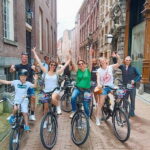
The route: from Daniël Willinkplein to May 7, 1945
This is a linear story ride through southwestern Amsterdam, starting and ending at the same meeting point (Tesselschadestraat 1). The tour starts at 11:00 am and returns to the meeting point at the end.
The opening ride at Victorieplein and the June 20, 1943 raid
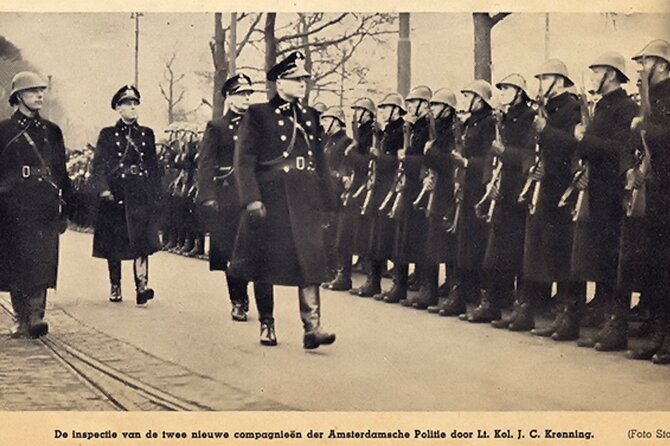
You begin at Victorieplein, then known as Daniël Willinkplein. The guide’s first big moment is the major raid on June 20, 1943, tied to what the Nazis called a Judenaktion—a mass roundup of Jewish residents.
The tour explains how groups were arrested at/near the foot of the skyscraper area, with Dutch police units involved and assistance from police volunteers linked to the NSB. From there, people were transported to places like Olympiaplein for registration and then onward to the Westerbork concentration camp in the east of the Netherlands.
What I like about starting here: it sets the tone with something concrete and specific. You immediately understand this isn’t a generic WWII tour. It’s about what happened in these exact blocks.
Merwedeplein: the Frank family home and the Anne Frank diary story
Next comes Merwedeplein 37-II (noted as the 3rd floor in American-style counting). This is the Frank family’s home. The guide connects Otto Frank’s choice in the summer of 1942 to move the family and acquaintances to Het Achterhuis (the Secret Annex) on the Prinsengracht, where Otto’s company was located.
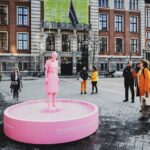
You’ll also find an Anne Frank statue on Merwedeplein, which makes the stop easy to ground visually.
Then the story tightens into something personal: the diary publication trail and how Jimmink, an active bookseller near Waalstraat, sold the first edition in 1947. The tour notes that it was at this bookshop that Otto Frank bought the diary for his daughter.
This is one of those moments where you feel the distance between history you’ve seen in print and a place you’re physically standing in. It’s not just “Anne Frank existed.” It’s “this purchase happened in this neighborhood.”
Tilex Bar history at Waalstraat 48 (now Café Blek)
At Waalstraat 48, opposite Merwedeplein, the tour points to the former Tilex Bar, associated with Tilly and Lex van Weren. The guide explains that Lex van Weren survived Auschwitz because he had to play his trumpet at executions.
That stop is heavy, but it’s also effective. It shows how occupation history wasn’t only about camps and big raids. It also involved day-to-day places—bars, services, workers—where fate could change quickly.


Cornelis Troostplein and the PBA barracks connection
At Cornelis Troostplein 23, you learn about the PBA-baracks, once part of a Catholic complex nicknamed the “peace parish,” with two convents and a school before the war.
Spring 1942 brought inspections: the chief of the Sicherheitsdienst (SD) / Gestapo, Rauter, inspected the PBA and met Reichsführer-SS Heinrich Himmler at Museumplein.
This stop works because it shows how buildings shift roles. A site can go from ordinary community life to machinery of control.
Museumplein: German offices, bunkers, and Flak batteries
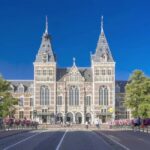
Then you ride to Museumplein, which the Germans transformed during the war into a stronghold.
From the concert hall facing view, houses on the left were occupied by German offices. The tour highlights how the United States consulate building once housed the Zentralstelle für Jüdische Auswanderung (Central Jewish “Emigration” office). Nearby you hear about the Ortskommandantur (Town Major) and the Feldgendarmerie (military police).
On the square in front, the guide points out the IJsclubterrein (Amsterdam skating club) area and how the Germans built a defended setup with bunkers and anti-aircraft (Flak) batteries. The tour notes that these bunkers were blown up after WWII.
You also pass the NSB HQ Amsterdam after the concert hall viewpoint. It’s an important detail because it shows collaboration was part of the occupation system, not just something done by distant enemies.
If you’ve only seen Museumplein in peacetime photos, this stop is a reality check.
Roelof Hartplein: coffee, restroom, and a practical reset
Before the second half, you get a short break at Roelof Hartplein, stopping at Café Wildschut for coffee and a restroom visit. This is described as about 10 minutes, and the admission ticket is free.
I like this pacing choice. It gives your legs a chance to breathe before the tour becomes even more detail-heavy.
Roelof Hartstraat: resistance photo development
At Roelof Hartstraat, the guide mentions a photo shop next to the library building that the Dutch resistance used to develop unique photos—images tied to early roundup activity in Amsterdam carried out by the SD/Gestapo and German police.
You also see a small monument remembering Jews taken from this neighborhood.
This is a good example of why the photo component matters. The tour isn’t only about “what happened.” It also shows how people tried to document and resist what was unfolding.
Beethovenstraat / Apollolaan: execution and retaliation in October 1944
At the corner of Beethovenstraat and Apollolaan, the tour describes an event roughly in front of number 6 in late October 1944: Herbert Oelschlägel, an SS officer and Gestapo agent, was executed by a Dutch resistance member.
The retaliation was brutal: the Sicherheitsdienst / Gestapo burned down two houses and executed 29 resistance fighters.
You’re also reminded that this street was called Euterpestraat then, and the guide ties in Gerrit van der Veen, described as a leader of an important Dutch resistance group.
Memlingstraat / Rubensstraat: two key Nazi oppression offices
Now the tour turns into a map-reading lesson, because you’re at the intersection of major oppression organizations.
At Memlingstraat / Rubensstraat, the guide points out:
- SD-HQ Amsterdam (SD Außenstelle under Willy Lages)
- Hausraterfassungsstelle, linked to stealing possessions of deported Jews, part of the Zentralstelle für Jüdische Auswanderung
The leader mentioned for the Hausraterfassungsstelle is Henneicke, described as a Dutch collaborator.
Then comes a key resistance strategy detail: in November 1944, resistance requested the Royal Air Force via a secret radio message to attack these headquarters, with the goal of destroying SD/Gestapo files. The guide connects this to the 149 (Typhoon) wing and Group Captain Denys Gillam DSO, DFC, AFC.
There’s also a safehouse reference near Rubensstraat / Gerrit van der Veenstraat, and the tour advises looking at the Stolperstein address.
Finally, the guide notes that in June 1944, this address was betrayed to the SD/Gestapo by a female informant referred to as V-Frau.
This cluster of facts is intense, but the tour keeps you oriented by tying each detail to a named location.
Olympiaplein / Parnassusweg: registration with help from Westerbork camp police
At Olympiaplein / Parnassusweg, the tour focuses on what happened to Jews arrested during the June 1943 raid. The guide explains that these people were registered by the SD/Gestapo on this square, with help from Jewish camp police sent from Westerbork.
That “help” detail is unsettling, but it’s historically important. It shows how the Nazis forced complex and heartbreaking participation structures into their systems.
Valeriusplein / Amsterdam Lyceum and the Luftwaffe HQ
At Valeriusplein, at the Amsterdam Lyceum, you learn that this school building served as the headquarters of the Luftwaffe toward the end of the occupation.
It’s another reminder of occupation reuse: normal institutions became command spaces.
Queen Emma’s statue and small defiance in 1940
Near the end, you stop at the Statue of Queen Emma on Emmalaan / Prins Hendriklaan. The guide describes how in summer 1940, people placed flowers at the statue as a defiance move against the German occupiers.
This moment is shorter, but it’s a relief after heavy details. It also makes the resistance story feel less like only raids and executions, and more like daily acts of courage.
The tour connects a resistance photographer, Charles Breijer, to a 1944 photo of a guard at the Kriegsmarine headquarters.
Ending with May 7, 1945: surrender tension and shootings
The tour closes with the final-day chaos on May 7, 1945. The guide describes dangerous situations between frustrated German troops and resistance fighters and directs you to a monument remembering victims of a shooting on the last day.
You then ride through Vondelpark toward Leidseplein, where the tour started—so you end with a visual reset to calmer Amsterdam streets, even though your head is still in 1945.
WWII photos: the tour’s secret weapon
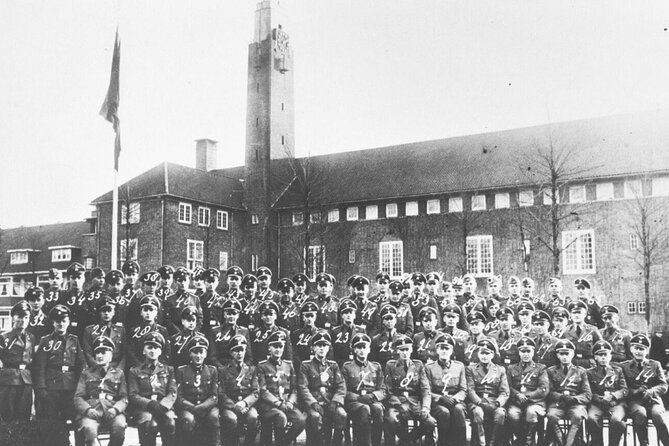
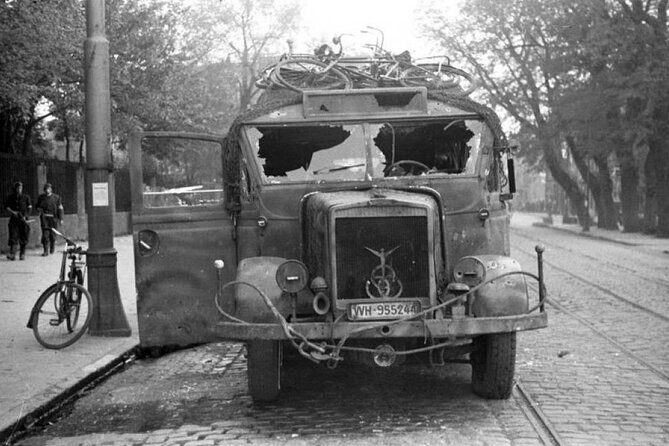
The most praised element across the experience is the photo setup. In practice, it works like this: you look at a street corner, then you see how it looked during the occupation through a period image—then the guide explains what those buildings and angles were used for.
It’s not just entertainment. It helps you keep the story anchored. When the guide says an office sat next door, you can actually find it visually, not just hear it.
This is why I think it beats many standard history routes that only tell you where to stand. Here, the photos teach you how to look.
The feel of the ride: safety, pacing, and car-free pockets
One of the practical wins is how you move. Several features point to a calmer ride: access to areas cars can’t reach, plus cycling instead of only walking. That means fewer bottlenecks and more chances to see residential streets where history hides in plain sight.
Safety also seems to be taken seriously. The tour is described as very safe for a biking experience, which matters because this is a subject where you don’t want to worry about balancing your bike while trying to follow names, dates, and locations.
And with a maximum of six riders, you avoid the common problem of a big group tearing apart your sense of where you are.
Coffee break timing: why the Roelof Hart stop is smart
Some history tours cram everything without a reset. This one inserts a short coffee and restroom stop at Roelof Hartplein.
Even if you’re not thinking about comfort, it’s a pacing tool. You’re moving from strong raid and office stories into more detailed resistance and documentation moments. A breather keeps the second half from feeling like one long lecture.
Price and value for a focused 2.5–3 hour history ride
The price is $66.09 per person, lasting about 2 hours 30 minutes to 3 hours 10 minutes. That’s not “cheap,” but it also isn’t a full-day museum-price situation.
What you get for the cost is:
- A guide-led route with multiple named sites
- WWII photos tied to present-day locations
- A small group size that supports real conversation
- Bike-based mobility so you cover more area than a walk would
Also, this tour is often booked roughly 11 days in advance, which suggests people plan it as a must-do rather than a last-minute experiment. If you like guided history with a personal thread (crime, resistance, survival stories, and daily life turned upside down), the price can feel fair.
Who should book this bike tour (and who might skip it)
This tour is a great match if you:
- Want WWII Amsterdam beyond the usual highlights
- Like history that’s tied to real street corners you can point to later
- Enjoy cycling and can handle 2.5–3 hours on a bike
- Prefer small groups over big coach-style crowds
I’d be more cautious if you:
- Don’t feel comfortable biking for the full duration
- Need a lot more time at stops rather than cycling between them at a steady pace
Quick practical checklist for your day
Here’s what you can plan around based on the tour details:
- Start: Tesselschadestraat 1 at 11:00 am
- Language: English
- Ticket: mobile ticket
- Group size: max six
- Includes: a short coffee/restroom stop at Café Wildschut (about 10 minutes)
- Ends: back at the meeting point
Riders also specifically advise bringing your bike, so don’t assume the tour provides one unless your booking confirmation says so.
Should you book this Amsterdam WWII cycling tour?
I’d book it if you want a WWII experience that’s specific, walkable-to-by-bike, and tied to what you can see right now. The best part is the photo-matching approach: it turns street corners into evidence you can understand, not just locations you pass.
If your trip is short and you’re already planning to do museums, this tour still earns its place because it covers neighborhood-scale stories across Amsterdam South—places that don’t always get the same spotlight as the better-known sites. It also helps that the ride is small-group and guided with strong navigation and safety.
If you’re on the fence, do this simple test: can you picture yourself cycling for about three hours while listening to detailed WWII stories at each stop? If yes, this tour is likely one of the most memorable ways to understand Amsterdam’s occupation years.
FAQ
How long is the Amsterdam in World War Two cycle tour?
It runs for about 2 hours 30 minutes to 3 hours 10 minutes.
Where do I meet the tour?
You meet at Tesselschadestraat 1, 1054 ET Amsterdam, Netherlands.
What time does the tour start?
The start time listed is 11:00 am.
What language is the tour offered in?
The tour is offered in English.
Is this a small group tour?
Yes. The tour has a maximum of six travelers.
Do I need a mobile ticket?
Yes, it’s a mobile ticket experience.
Is there a break during the tour?
There’s a short stop at Roelof Hartplein for coffee and a restroom visit, about 10 minutes.
What if my plans change and I need a refund?
Free cancellation is available up to 24 hours before the start time for a full refund. If you cancel less than 24 hours before, the amount paid is not refunded.