REVIEW · CANAL CRUISES
Amsterdam: Historic City Sightseeing Canal Cruise
Book on Viator →Operated by Amsterdam Circle Line · Bookable on Viator
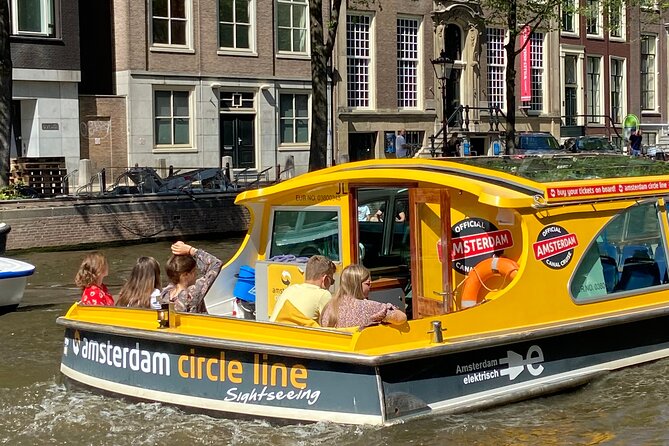
Amsterdam’s canals move fast. That’s the point. This 1-hour cruise is an efficient way to see a stack of major landmarks from the water, from the UNESCO-listed Canal Ring to the Amstel waterfront. I like that the experience is built for time-pressed sightseeing, and I also love the easy start right by the Anne Frank House so you don’t waste your first precious hour getting oriented.
Two big wins: you get 400+ years of canal-belt history in one smooth loop, and you’re treated to a mix of old architecture and newer city highlights without the stress of walking between neighborhoods. One thing to think about: the narration is delivered through a voice-over system, and in some conditions it can be tough to hear or switch languages cleanly, especially if you’re farther from the audio source.
In This Review
- Key Highlights to Focus On
- Why This 1-Hour Canal Cruise Is a Smart First Step in Amsterdam
- Finding the Boat Near the Anne Frank House (No Map Guessing Needed)
- Cruising the UNESCO Canal Ring: The Architecture Looks Different from Water
- Starting Point: Museum of the Canals and a Fast Intro to the Canal Story
- Anne Frank House From the Water: A Quiet, Heavy Landmark in a Busy City
- Westerkerk: Calvinism, Central Location, and a Landmark on the Canal Belt
- Houseboat Museum on the Hendrika Maria: How Canal Living Changes Your Perspective
- Canals Worth Knowing by Name: Leidsegracht and De Beulingsloot
- Bartolotti House on Herengracht: Merchant-Era Wealth in Brick and Proportions
- Melkmeisjesbrug: A Bridge Named for Milk, Rebuilt Again and Again
- Brouwersgracht and the Jordaan Edge: A Canal Belt Boundary You Can Feel
- Church-to-Concert Hall to Hotel Tunnel: A Landmark with Layers
- Pierre Cuypers’ Amsterdam Centraal and the IJ Waterfront Shift
- EYE Filmmuseum: A Modern Building You Can Actually See Clearly
- The Stopera: City Hall and Opera Under One Roof (Yes, It’s Really Called That)
- Down the Amstel: Hermitage Amsterdam and River Energy
- The Narration Reality: English, Audio Clarity, and Where to Sit
- Comfort Tips: Cold Weather, Views, and Keeping It Relaxing
- Should You Book This Canal Cruise by Anne Frank House?
- FAQ
- How long is the Amsterdam historic canal sightseeing cruise?
- Where is the meeting point?
- Is the tour offered in English?
- Do I receive a mobile ticket?
- What is the price per person?
- How big is the group?
- Are service animals allowed?
Key Highlights to Focus On
- Anne Frank House area pickup: the meeting point is easy to find right in front of the museum.
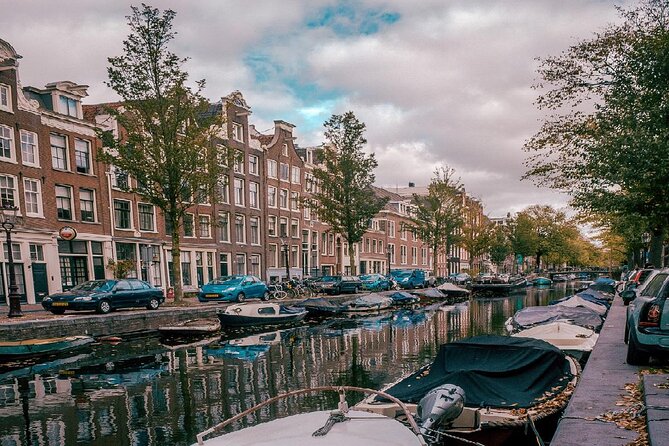
- UNESCO Canal Ring views: churches, canal houses, and landmark facades from canal level.
- Iconic canal details: you’ll pass by structures like the Melkmeisjesbrug bridge with centuries of history.
- A fast hit of both old and new: Canal Ring sights plus the IJ and EYE Filmmuseum area.
- Amstel waterfront payoff: Hermitage Amsterdam and the Stopera area round out the route nicely.
- Short and doable: about an hour is perfect after a museum day or before dinner plans.
Why This 1-Hour Canal Cruise Is a Smart First Step in Amsterdam
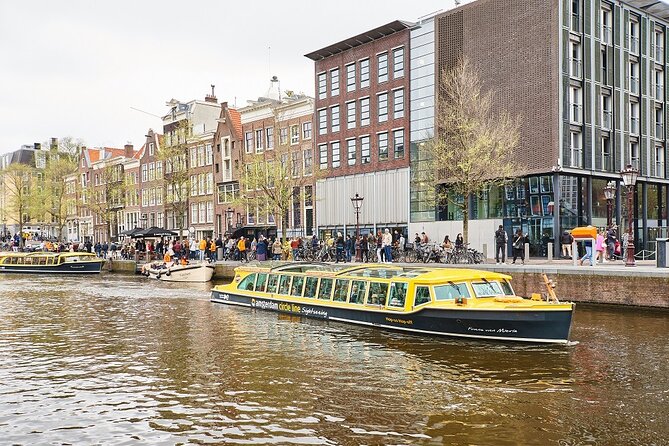
If you only have a day or two, walking every canal block can feel like a strategy built on good intentions and bad weather. This cruise is a clean alternative. It’s short enough that you can actually fit it between major sights, yet it still covers a lot of ground by water.
At about $18.71 per person for roughly an hour, the value comes from compression. Instead of spending 2–3 hours stitching together multiple neighborhoods on foot, you’re getting views of the canal belt plus key waterfront architecture in one continuous ride. For solo travelers, it’s also a calmer way to get your bearings. Many people find the boat lets you see details you’d miss from street level.
My practical takeaway: this is ideal when you want context. You’ll see what “the canals made Amsterdam” looks like, then you can decide where to walk next—Jordaan, the Museum area, or the riverfront—based on what you like most from the boat.
You can also read our reviews of more boat tours in Amsterdam

Finding the Boat Near the Anne Frank House (No Map Guessing Needed)
The meeting point is in front of the Anne Frank House, which is a big deal in Amsterdam. You’re starting in a place that’s central, landmarked, and easy to spot. Even if it’s your first time in the city, you won’t need a deep-dig into transit routing to show up on time.
You’ll use a mobile ticket, and the experience is offered in English. That matters because you can focus on the sights instead of juggling translation apps. The tour also runs with a maximum group size of 68, so you’re not dealing with a giant crowd system, but it’s still a real sightseeing departure—go early enough to settle.
Tip: If you’ve just visited Anne Frank House, plan your timing so you’re not rushing. Starting from right there is convenient, but Amsterdam queues and canal-step boarding can eat up “extra minutes” fast.
Cruising the UNESCO Canal Ring: The Architecture Looks Different from Water
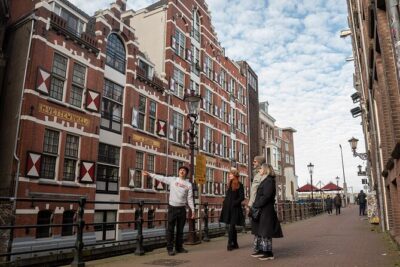
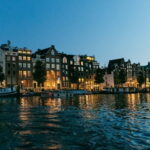
Amsterdam’s Canal Ring is famous, but from the water it gets sharper. From street level, you tend to scan for houses, windows, and bridges. From the canal, you start noticing how buildings face the water and how the city’s street grid wraps around waterways.
The cruise passes landmarks that span the city’s long timeline—churches, merchant-era canal houses, and later civic architecture. You’ll also float by the kind of structures that make Amsterdam feel like it was designed for boats: the consistent canal width, the bridge density, and the way facades line up with sightlines.
What I like most about this part is that it’s visually legible. Even if you’re not a canal architecture expert, you can tell what’s old (brick, compact forms, historic canal houses) and what’s newer (cleaner lines, modern waterfront buildings). It helps you make sense of Amsterdam as a layered city instead of a single postcard scene.
Starting Point: Museum of the Canals and a Fast Intro to the Canal Story
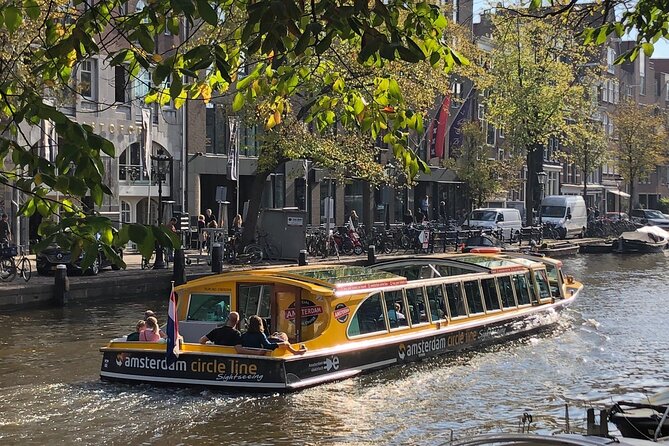
The ride starts with the idea that canals weren’t just scenery. They shaped daily life, commerce, and expansion. The cruise begins by referencing Amsterdam’s “canal age” right away, and it sets you up to watch for history signals as you go.
You’ll pass churches and other recognizable landmarks as the route moves through historic waterways. That matters because it gives your eyes something to do. Instead of just watching water slide by, you’re mentally connecting each stretch of canal to what made Amsterdam Amsterdam.
This is the part you’ll appreciate most if you haven’t spent time reading up ahead of your trip. You get a baseline story in about a minute, and then the rest of the cruise becomes a highlight reel you can actually interpret.
Anne Frank House From the Water: A Quiet, Heavy Landmark in a Busy City
Even if you don’t go inside the Anne Frank House museum, seeing it from the canal side hits differently. The building sits on the Prinsengracht, close to the Westerkerk area in central Amsterdam.
Here’s what you’re looking at from the boat perspective: it’s the writer’s house and biographical museum dedicated to Anne Frank. During World War II, Anne Frank hid with her family and four others in the hidden rooms at the rear of the building, known as the Secret Annex. She didn’t survive the war, but her diary was published in 1947, and about a decade later the Anne Frank Foundation was established to protect the property from developers.
From a sightseeing standpoint, the value is simple: you get a sense of where the story lived in the real city. From the canal, the house sits within the same canal-belt urban layout you’ll see all around you—history embedded in everyday Amsterdam geography.
Practical note: this stop can feel emotional even for people who keep it brief. If you want to keep the mood lighter, you can mentally switch gears as soon as the boat moves past and the route starts showing more civic and architectural variety.
You can also read our reviews of more city tours in Amsterdam

Westerkerk: Calvinism, Central Location, and a Landmark on the Canal Belt
The Westerkerk is a strong counterpoint to the Anne Frank House’s wartime story. This Reformed church belongs to Dutch Protestant Calvinism and stands in the western part of the canal belt area (Grachtengordel), near the Jordaan, between the Prinsengracht and Keizersgracht.
From the water, churches like this tend to read like skyline anchors. The boat gives you a consistent canal-level view of the building’s massing and setting, so you can understand why it’s such a central orientation point in the neighborhood.
If you’re the kind of person who likes to learn while seeing, this is a good moment to slow down mentally. Amsterdam has lots of churches, but the Westerkerk’s position in the Grachtengordel makes it especially useful as a “this is where we are” reference.
Houseboat Museum on the Hendrika Maria: How Canal Living Changes Your Perspective
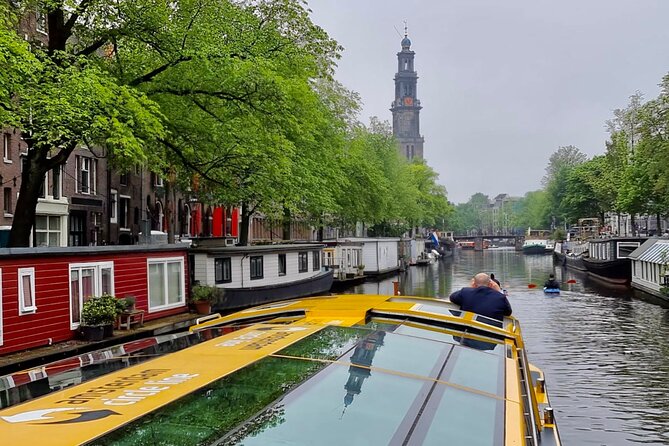
One of the most fun segments is when you get to the Houseboat Museum. The museum is inside the Hendrika Maria, a former cargo ship built in 1914. What’s now a cozy living space used to be a practical holding area for goods.
This is one of those moments where the canal cruise stops being purely scenic and turns a little human. You’re seeing how people adapted the canal environment for daily life. Even the fact that a cargo ship can be comfortably lived in helps explain why Amsterdam’s waterways didn’t just create beauty—they created housing solutions.
From the boat, you can’t fully replicate being inside, but you can see the idea: Amsterdam’s flexibility. You’ll likely remember this stop later when you spot houseboats elsewhere on your trip.
Canals Worth Knowing by Name: Leidsegracht and De Beulingsloot
Amsterdam is full of canals, but some have personality. The cruise includes Leidsegracht, a cross-canal that connects Herengracht, Keizersgracht, Prinsengracht, and Lijnbaansgracht. It flows into the Singelgracht area at Marnixstraat.
It also passes De Beulingsloot, described as one of the oldest and shortest canals in the center of Amsterdam. These smaller, older stretches help you notice how the canal network isn’t one uniform “pretty ring.” It’s a complex set of corridors with different ages and roles.
Why you’ll enjoy this: names start turning into maps in your head. When you return to the streets later, you’ll recognize canal patterns faster, and you’ll spend less time wandering randomly.
Bartolotti House on Herengracht: Merchant-Era Wealth in Brick and Proportions
The cruise also goes by the Bartolotti House at Herengracht 170–172. It was built around 1617 for Willem van den Heuvel tot Beichlingen, one of the richest Amsterdammers of the time. He inherited wealth through a childless uncle by marriage, Giovanni Battista Bartolotti, a merchant from Bologna.
What’s useful here isn’t just the genealogy. It’s that you can see the wealth in the architecture style and scale as it lines up along the canal. When you know the “about when” behind a building, it becomes easier to interpret the city’s evolution: why some facades look sturdier and more formal, and why other sections feel later or differently planned.
If you’re doing a first-timer Amsterdam trip, this is the kind of canal-house detail that makes the whole cruise feel worth it, because it adds meaning to the visuals.
Melkmeisjesbrug: A Bridge Named for Milk, Rebuilt Again and Again
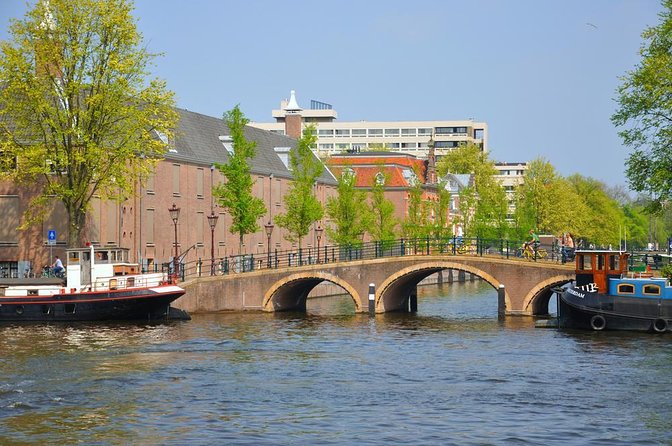
The Melkmeisjesbrug is a fixed bridge in Amsterdam-Center with a history stretching back centuries. There has been a bridge here for a long time, and it appears on maps signed by Balthasar Florisz. van Berckenrode (1625), Joan Blaeu (1649), and Daniël Stalpaert (1662).
The bridge’s modern history starts in 1883, when a pedestrian drawbridge was replaced by a permanent bridge. Later, the passage was found too narrow, leading to renewed abutments and an updated design in 1903 using paraboolligger construction with iron sickle girders. Another steel version followed in 1966.
It’s named after the milk market that once took place here. Later a catering establishment built nearby used a milkmaid image as a sign, which helped reinforce the name. There’s also a note that this may be where the first type Amsterdammertje was placed.
Even if you don’t memorize every date, this stop is a reminder that Amsterdam keeps rewriting its infrastructure. The city changes, but the canal geography stays, so bridges become a kind of long-running storyline.
Brouwersgracht and the Jordaan Edge: A Canal Belt Boundary You Can Feel
The cruise passes along Brouwersgracht, which connects the Singel with the Singelgracht and marks the northwestern border of the Grachtengordel. Between the Prinsengracht and the Singelgracht, it also forms the northern border of the Jordaan neighborhood.
One detail that helps you picture the city: house numbers on multiple major streets count from Brouwersgracht. That makes it a true structural anchor, not just a pretty waterway.
There’s also a neat modern recognition: in 2007, Brouwersgracht was voted the most beautiful street in Amsterdam by readers of Het Parool (out of 150 nominations). That’s not just trivia. It means this canal stretch is a “don’t skip” street even on a short visit.
Church-to-Concert Hall to Hotel Tunnel: A Landmark with Layers
One section of the route is tied to a church designed by Adriaan Dortsman, opened in 1671. It was nearly destroyed in 1822 and rebuilt in 1826. The organ was built by J Batz in 1830 and restored in 1983.
In 1935, the Lutherans left the building, and it became a concert hall. In 1975, a tunnel was built by the neighboring Sonesta Hotel (today called the Renaissance Amsterdam Hotel) for the hotel’s own access, with the hotel renting the church from the Lutheran church, which still remains the owner.
Then came a dramatic turn: in 1983, the church was closed for restoration, and in 1993, the dome caught fire. The church was restored again after that.
From the water, you don’t need to know every restoration date to get the point. This is Amsterdam as a place where old buildings get new roles. The canal route gives you a way to see that adaptation without having to stop and walk for hours.
Pierre Cuypers’ Amsterdam Centraal and the IJ Waterfront Shift
The cruise moves toward the IJ, a body of water in North Holland that’s known as Amsterdam’s waterfront. It has the feeling of the city opening up.
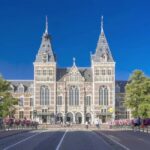
You’ll also spot Amsterdam Centraal, designed by Pierre Cuypers, who is also known for the Rijksmuseum. It’s interesting that while he’s the principal architect, it’s believed his focus was mostly on decoration rather than the structural design, which was handled by railway engineers. That contrast gives you a different lens: art and engineering working side by side.
If you like architecture, this is where your cruise starts balancing nostalgia with modern city function. The canal belt is history. The IJ and station zone are Amsterdam in motion.
EYE Filmmuseum: A Modern Building You Can Actually See Clearly
At the waterfront sits the EYE Filmmuseum, designed by Delugan Meissl Associated Architects (also known for the Porsche Museum in Stuttgart). The building includes two gallery exhibition spaces and multiple cinema rooms: one 300-seat cinema, two 127-seat cinemas, and a smaller about-67-seat cinema.
From the boat, you can get a good look at how a modern museum building sits against the water. It’s a nice contrast to the older canal houses and churches. This is also one reason the cruise can work well even if you’ve already done a museum day—you’re still seeing museum culture, just from a moving viewpoint.
The Stopera: City Hall and Opera Under One Roof (Yes, It’s Really Called That)
One of Amsterdam’s most recognizable modern complexes is the Stopera, a building complex housing both the city hall of Amsterdam and the Dutch National Opera and Ballet. It’s the opera house for Dutch National Opera, Dutch National Ballet, and Holland Symfonia.
Architects: Wilhelm Holzbauer and Cees Dam.
And the name? It’s not some word mash-up. Stopera is an abbreviation of the protest slogan Stop the Opera. The theater has never used the name in their communication.
From the water, this area reads like a statement piece. If you care about how cities evolve—how they build for culture and civic life—this is a satisfying closing note on a canal-focused ride.
Down the Amstel: Hermitage Amsterdam and River Energy
The cruise heads toward the Amstel river. It flows northwards to the IJ and is known for events like Liberation Day concerts, the Head of the River rowing match, and Amsterdam Gay Pride boat parade.
The Amstel also has a deep formation story: it was formed when a freshwater river cut into a tidal channel of the IJ around 1050 BC (the Damrak and Rokin areas).
Seeing it from the water gives those events a setting. You’re not just imagining the river as a line on a map. You’re seeing the stage.
Then you pass Hermitage Amsterdam, a satellite museum of the Hermitage Museum of Saint Petersburg. It’s located on the banks of the Amstel in the former Amstelhof, a classical-style building from 1681. The museum’s larger exhibition setup opened in 2009, and it’s described as the largest satellite of the Hermitage Museum with a total area of 12,846 m² and exhibition area of 2,172 m² across two large exhibition halls and smaller rooms.
Even if exhibitions don’t tempt you, the building setting is the point. This is one more example of Amsterdam layering history: 17th-century architecture used for modern public culture.
The Narration Reality: English, Audio Clarity, and Where to Sit
Most of the experience centers on guided narration through a voice-over system (not always a live explanation). Some people love it for being timed and clear. Others report the audio could be harder to hear, and that language switching may not pause cleanly. There are also mentions that in certain cases, sound can drift into a single language.
Here’s how to protect your enjoyment:
- Choose seats where you’re closer to the audio source.
- If you’re sensitive to hearing, consider bringing small ear protection or anything that helps you focus on audio (you’ll thank yourself in wind).
- If the language switch feels confusing, just keep your eyes on the landmarks—many are obvious from the canal approach.
On some departures, you might hear extra humor from a captain or guide (names like Robert and Rolif show up in praised experiences). If your crew leans into storytelling, the cruise feels less like a slideshow and more like a guided city walk—just floating.
Comfort Tips: Cold Weather, Views, and Keeping It Relaxing
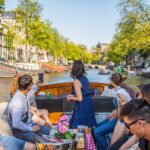
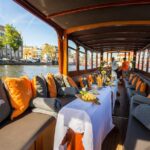
This is a relaxing hour, and the boat setup lets you choose between staying inside or outside depending on the weather. In cold or windy conditions, comfort matters more than you think. I’d dress for damp and chill, not just dry-air. One common wish that comes up is adding hot drink options for colder rides, so plan to be a little proactive with warm layers.
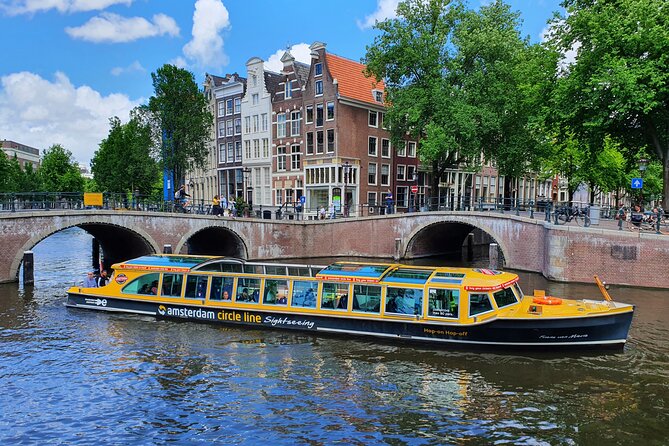
Also think about your viewing angle. If you want unobstructed shots, windows and the glass ceiling can help a lot. If you’re aiming for photos, step to the best window line early so you’re not scrambling mid-route when the boat is already moving and the bridge line is changing.
Should You Book This Canal Cruise by Anne Frank House?
I think you should book this if you want a fast, high-value overview of Amsterdam that combines the canal belt with major waterfront architecture. It’s also a strong choice when your day is packed: museum first, cruise second, and then you decide where to walk on foot.
Skip it (or at least manage expectations) if you’re very picky about live, highly detailed commentary. Because the narration is often audio-based, hearing quality and clarity can vary. If you’re the type who needs constant expert guidance for every building, you might prefer a walking tour with more direct back-and-forth.
Best match:
- First-time visitors who want a quick “map in motion”
- People who already plan to do Anne Frank House and want to see the canal neighborhood view
- Travelers who like architecture, bridges, and the way Amsterdam uses water for everyday life
FAQ
How long is the Amsterdam historic canal sightseeing cruise?
It lasts about 1 hour.
Where is the meeting point?
The meeting point is in front of the Anne Frank House.
Is the tour offered in English?
Yes, it is offered in English.
Do I receive a mobile ticket?
Yes, the tour includes a mobile ticket.
What is the price per person?
The price is $18.71 per person.
How big is the group?
The experience has a maximum of 68 travelers.
Are service animals allowed?
Yes, service animals are allowed.
If you want, tell me your travel dates and whether you’re pairing this with Anne Frank House or the Museum Quarter. I can suggest a tight schedule for the best light and least waiting.