REVIEW · 2-HOUR EXPERIENCES
Amsterdam Pedicab City Tour (2 hours)
Book on Viator →Operated by Bram de Haan · Bookable on Viator
Two wheels make Amsterdam feel manageable fast. This private, pedal-powered city tour is a smart way to see key spots from Dam Square to Museumplein without wearing yourself out. I like the way the tour mixes classic landmarks with the city’s quieter corners, and the Bram de Haan approach adds context with old maps and photos.
My favorite part is the attention. You get a private ride at a pace that lets you stop for pictures and questions, even if rain pops up. One consideration: most stops are quick and mainly outside views, so if you’re hunting for museum time, this is best as an orientation, not a ticket to every interior.
In This Review
- Key things to know before you go
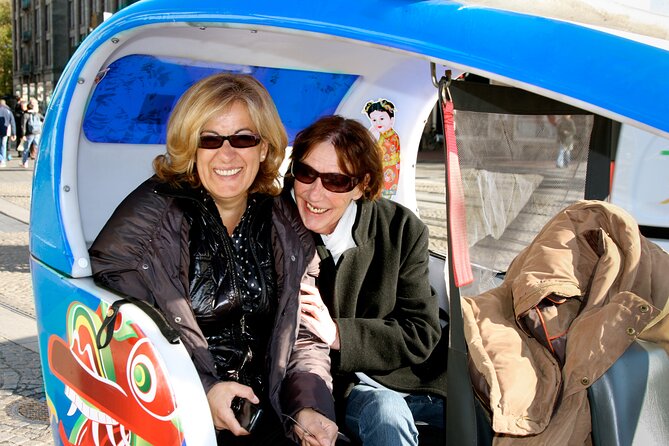
- The appeal of a private blue pedicab in the canal core
- Meet Bram de Haan: how the tour stays personal and flexible
- Dam Square, Zeedijk, and Chinatown: the start of Amsterdam’s story
- Nieuwmarkt and the city-gate idea: why the layout matters
- Montelbaanstoren and the view over de oude Waal
- Rembrandt House (outside only) and Jodenbuurt’s surviving streets
- Portuguese Synagogue area and the Holocaust Names Monument
- Passing the H’ART Museum and seeing Museumplein the right way
- The Rijksmuseum bicycle tunnel and Pierre Cuypers views
- What you’re really paying for with $237.65 per group
- Practical tips: rain, comfort, and what’s not included
- Should you book this Amsterdam pedicab city tour?
- FAQ
- How long is the Amsterdam pedicab city tour?
- What does the tour cost and how many people can ride?
- Is this a private tour?
- Is pickup included, and where do I meet the pedicab?
- What language is the tour offered in?
- What’s included in the price?
- Are any museum tickets included?
- What should I know about weather?
Key things to know before you go
- Private group, just you: your guide and pedicab are for your group only (up to 2 people).
- A local’s pace with photo pull-offs: you’re not stuck marching on a set bus schedule.
- Maps and past-versus-present photos: the guide uses visuals to explain how Amsterdam changed.
- Jewish Amsterdam in a focused route: Jodenbuurt, the Portuguese Synagogue area, and the Holocaust Names Monument are part of the ride.
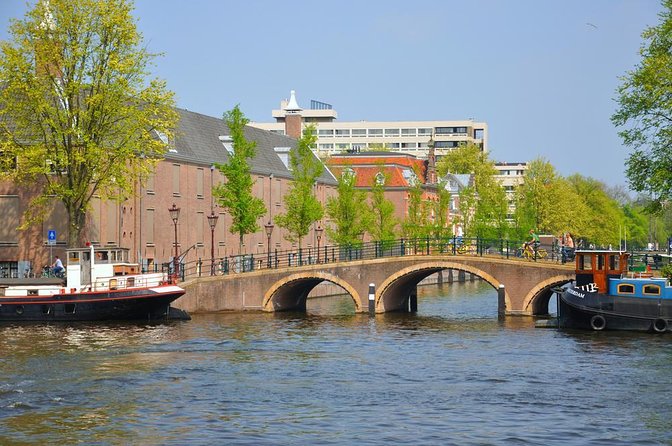
- Canals and bridges built for views: expect plenty of photo-friendly angles, especially around the Amstel.
- Weather-ready comfort: waterproof protection is provided if you get caught in rain or chilly wind.
The appeal of a private blue pedicab in the canal core
Amsterdam’s center is compact, but it can still feel like a lot when you’re on foot. A pedicab ride keeps you moving through the busy core while you sit back and watch the city unfold street-by-street. You get the feel of the historic streets and canal houses without constantly checking your footing, dodging bikes, or losing time to crowd bottlenecks.
This one is also practical in a very Amsterdam way: it’s eco-friendly, and it works well for a short stay. In about two hours, you can cover multiple neighborhoods that usually take far longer to connect on foot. The tour is private transportation for your group, so you’re not squeezed into a larger group where you have to accept the leader’s timing.
The price can look steep at first glance. But you’re paying for a small, dedicated experience: a private guide, a dedicated pedicab, and the ability to stop when something catches your eye. If you’re traveling as a couple, it’s easier to justify because it’s priced per group (up to 2 passengers), not per person multiplied by a crowd.
You can also read our reviews of more city tours in Amsterdam



Meet Bram de Haan: how the tour stays personal and flexible
The tour runs with a local guide, and many visitors highlight Bram de Haan by name. The big difference is how the ride feels like a conversation instead of a lecture you have to survive. Bram uses old maps and photos so you can compare what you’re seeing now with how the same areas looked in earlier centuries.
You’ll also notice a pacing style that feels considerate. There are set stops along the route, but the guide pulls over when you want a closer look or want to ask questions. If it’s raining, protection is part of the setup; you’re not just handed an umbrella and sent on your way.
That flexibility matters for two types of people:
- If you want a fast orientation to Amsterdam, you can get a lot of context in a short time.
- If you have specific interests (architecture, canals, Jewish history, city evolution), your guide can steer the commentary toward what matters to you.
Dam Square, Zeedijk, and Chinatown: the start of Amsterdam’s story
You begin at Dam Square, which is the classic heart of the old center. The stop is short, but it’s timed well: you see the Royal Palace area, the New Church, and the National Monument all in one sweep. Even if you don’t go inside, you understand why this square is the city’s starting point.
Next comes Zeedijk, one of the oldest dikes around the old center. It’s also the setting for the oldest cafe of Amsterdam, with an original interior and an old-world vibe. The guide also teases a darker side of what’s happened in this area over time, and that contrast is part of why this stop works. You get atmosphere plus story, not just a photo spot.
Then the route shifts into Chinatown. Amsterdam’s Chinatown is described as the oldest Chinese neighborhood on the European mainland. You’ll see how it functions day-to-day, with Chinese restaurants and supermarkets, plus a Chinese temple. The value here is simple: you’re not just looking at buildings, you’re seeing how neighborhoods become communities with their own rhythm.
Quick stops can be a drawback if you like long wandering. But the trade-off is you stay fresh and still see a wide spread of Amsterdam without exhausting your legs.
Nieuwmarkt and the city-gate idea: why the layout matters
At Nieuwmarkt, you’ll get a big explanation in a small space. The square is tied to the old citygate—an important entrance when Amsterdam was walled and fortified before the 17th-century expansion. Standing here (even for a brief stop) helps you connect the dots between modern streets and older city defenses.
Nieuwmarkt also sets up what comes next: you start noticing how Amsterdam’s growth shaped everything that follows—canals, borders, and neighborhood identities. When a guide talks about city gates and expansions, it’s not just trivia. It helps you understand why the canal network and older streets feel structured, even when the city looks chaotic from a distance.
Montelbaanstoren and the view over de oude Waal
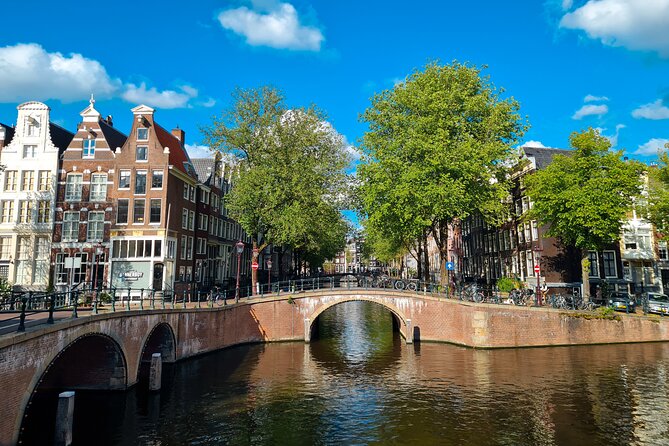
From Nieuwmarkt, you head toward Montelbaanstoren, an old ship watch tower tied to the early 16th-century defense line. This is one of those spots where a short stop still lands well, because the tower has a clear purpose in the story of the city.
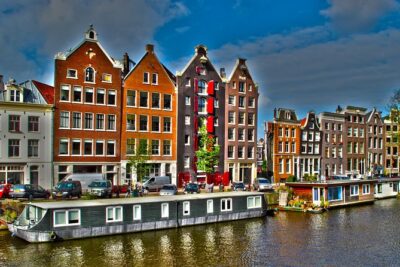
The bonus is the view. From this area, you get outlooks over de oude Waal and the line-up of houseboats against the backdrop of 17th-century canal houses. It’s not a long scenic stroll, but it’s a memorable snapshot that helps you picture how water and architecture shaped daily life.
A small practical note: for the best experience, keep your camera ready here. The angles can change fast as you move through the city, and this stop is the kind you’ll want to capture in the moment rather than later.
You can also read our reviews of more tours and experiences in Amsterdam



Rembrandt House (outside only) and Jodenbuurt’s surviving streets
The tour includes a look at Rembrandt’s house from the outside. If you want to enter the Rembrandt House Museum, that’s possible, but admission isn’t included on this ride. So think of this as a framing stop: you see the location linked to Rembrandt during his successful years, and then you decide if you want to add museum time afterward.
Then comes a deeper turn into Jodenbuurt. This area is tied to the old Jewish quarter. After World War II, much of the center was broken down, but there are still buildings, synagogues, and streets that survived. The stop includes time to take it in—10 minutes—so it doesn’t feel like a hurried drive-by.
What makes this part valuable is that it treats the neighborhood as more than a label. You’re not only learning names. You’re learning how a community’s physical presence connects to what remains today.
Portuguese Synagogue area and the Holocaust Names Monument
The Portuguese Synagogue of Amsterdam is one of the route’s most important architectural stops. It’s described as the largest synagogue and among the first in Western Europe that Jewish people were allowed to build, with construction dated to 1675. You’ll look mainly from the outside, which keeps the tour moving while still giving you a landmark anchor.
Opposite the synagogue, the route notes other synagogues that now form part of the Jewish museum area. Even if you don’t enter anything here on the ride, you get an immediate sense of how these places cluster and how the city preserved key sites even as it changed around them.
After that, you pass by the National Holocaust Names Monument. This is one of the few places in Amsterdam where the sheer scale is part of the message: 102,000 brick stones with names. The stop time is brief, but it’s a powerful moment on the route because it interrupts the lighter sightseeing rhythm and grounds the tour in remembrance.
If you prefer to spend longer at memorials, this is the only place where you might want to plan additional time later. The pedicab tour keeps the pace moving, so consider pairing it with a separate stop if this topic matters a lot to you.
Passing the H’ART Museum and seeing Museumplein the right way
On the route, you’ll pass the H’ART Museum area. The background detail here is the building’s earlier role: it used to be a monumental widow house care house built in the 17th century, and it’s now part of the Russian Hermitage Museum. Even without going inside, that kind of reuse story helps you see Amsterdam as a city that keeps adapting older structures.
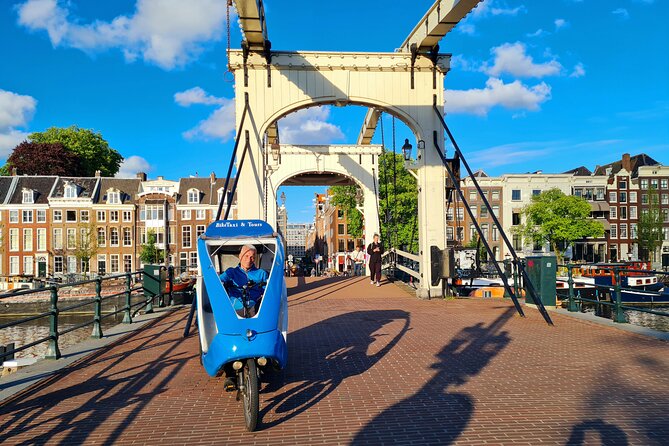
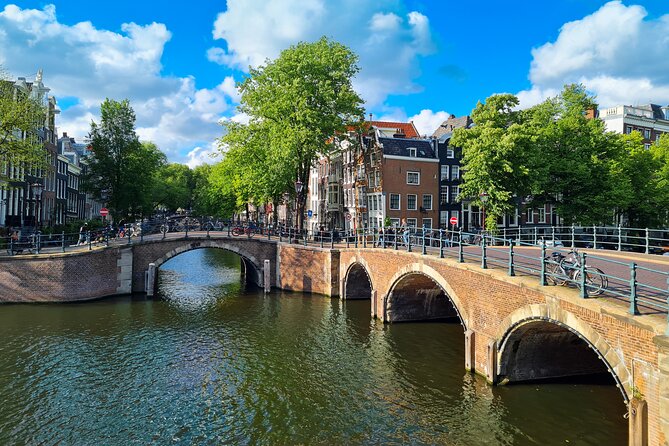
Then you reach Magere Brug, the skinny bridge that becomes especially iconic at night with light bulbs. The tour includes a stop that pairs the bridge with a view over the Amstel, Amsterdam’s main and widest canal. This is a very good photo moment, and it also helps you understand Amsterdam’s geography. When you can see the waterline clearly, the city stops feeling like random canals and starts feeling like a connected system.
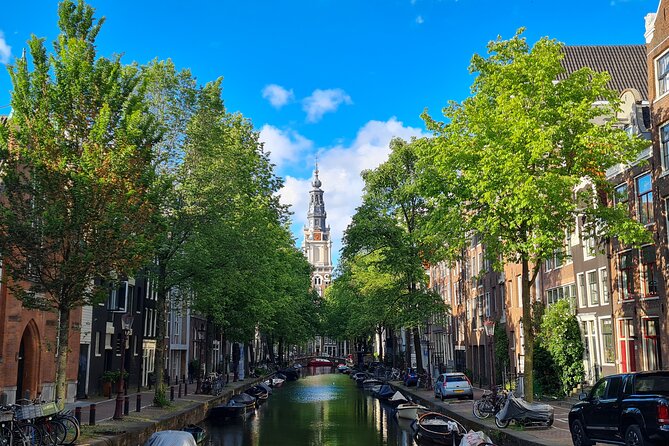
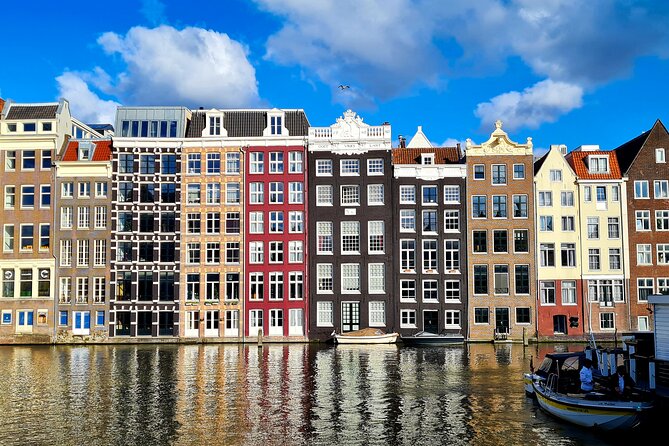
From there, you move into the Canal Ring (Grachtengordel). You’ll get a guided explanation of the 17th-century expansion pattern, including the half-circle structure around the old center. The canal houses were built for successful merchants, and you’ll be told that while they share typical similarities, each one is slightly different. That detail is exactly what makes the canal belt satisfying to look at instead of just pretty.
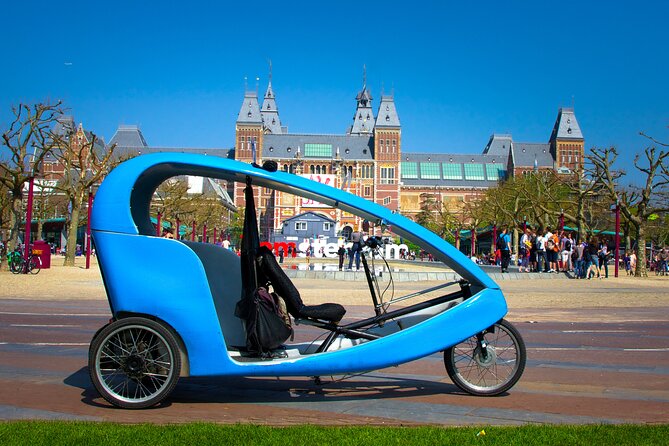
Finally, you arrive at Museumplein. It’s described as Amsterdam’s biggest and one of its nicest squares, with the Rijksmuseum on one side and the Concertgebouw on the other. Nearby you’ll find other major museums like the Van Gogh museum, the Stedelijk museum, Moco museum, and the Diamond museum. On the ride, you’ll stop mainly for views and context, which is perfect if you want a “which museum should I pick?” moment instead of committing on the spot.
The Rijksmuseum bicycle tunnel and Pierre Cuypers views
One of the most distinctive ride segments is the passage through the famous bicycle tunnel under the Rijksmuseum. The tour notes that classical music from street artists is often heard there. You might catch it while you’re rolling through, and even if you don’t, the tunnel itself is a very Amsterdam detail—bikes built into the city’s architecture like they belong there, because they do.
After the tunnel, the tour heads toward Museumplein for a good look at the back of the Rijksmuseum. The building is described as completed in 1885 and designed by Pierre Cuypers, designed by a Catholic architect. Getting the back view matters because it can be easy to focus only on the iconic front-facing photos. Seeing another angle helps you appreciate the building as a full composition.
This segment is short, but it’s a good finale because it blends city movement with a clear landmark payoff.
What you’re really paying for with $237.65 per group
At $237.65 per group for up to 2 people, you’re not buying a long museum day. You’re buying a private, guided route that blends multiple neighborhoods into one logical walk-through. For value, that matters because Amsterdam sightseeing costs time, and time is what most first-timers run out of.
Here’s the real value equation I’d use:
- If you have limited time and want more coverage than walking allows, the pedicab helps.
- If you want context you can actually remember later, the guide’s maps and photo comparisons make the story stick.
- If you care about specific themes like Jewish Amsterdam and the Holocaust Names Monument, this route groups them in one ride instead of forcing you to piece it together yourself.
If you’re the kind of person who only wants museum entrances and long indoor time, you may feel the ride is too “outside focused.” But for an orientation and city understanding, it’s a solid use of a morning or afternoon.
Booking can also be a factor. This experience is typically booked about 77 days in advance on average, so planning ahead helps you lock in the time you want.
Practical tips: rain, comfort, and what’s not included
A couple of practical points make a big difference here.
First, weather. The experience requires good weather. That said, when rain or chilly wind shows up, waterproof protection is provided, including blankets mentioned in guide experiences. Dress for cool air and keep your layers light and flexible.
Second, comfort for short breaks. You’ll get a chance for photos and a little viewing time at each stop, but the stops are timed. If you’re planning to take lots of photos, keep your phone or camera charged and ready. The guide’s habit of pulling over helps, but you still need to work within a two-hour structure.
Third, what’s not included. Snacks aren’t included. Also, Rembrandt House Museum entry isn’t included even though you’ll view Rembrandt’s house from the outside. If you care about museums, plan to add those separately.
Finally, weight and capacity limits matter. The max total passenger weight is limited to 210kg, and only one pedicab is available per timeslot. That’s normal for a private vehicle setup, but it’s worth checking if you’re traveling with multiple people or heavier luggage.
Should you book this Amsterdam pedicab city tour?
Book it if you want a fast, guided introduction that covers Dam Square, canals, bridges, and the Jewish history route in a single sweep. It’s especially worth it when you like learning through visuals like old maps and past-versus-present photos, and when you want a pace that lets you stop for questions and photos without awkward group timing.
Skip it (or add museum days on top) if you only want long interior visits, snack planning is a priority you’ll want taken care of, or you’re traveling when weather is likely to be poor. In Amsterdam, that last point matters because the route works best when you can actually enjoy being outside.
If you want one practical strategy: use this as your orientation ride, then decide later which museums or neighborhoods you want to return to with more time.
FAQ
How long is the Amsterdam pedicab city tour?
It runs for about 2 hours.
What does the tour cost and how many people can ride?
It costs $237.65 per group, with a maximum of 2 passengers.
Is this a private tour?
Yes. It’s private, meaning only your group participates.
Is pickup included, and where do I meet the pedicab?
Pickup is offered. The instruction is to wait in front of your hotel and look for the blue pedicab.
What language is the tour offered in?
The tour is offered in English.
What’s included in the price?
The included item is private transportation.
Are any museum tickets included?
Admission isn’t included. The Rembrandt House Museum is view-only on the outside, and entering is possible but not included in this tour.
What should I know about weather?
The experience requires good weather. If it’s canceled due to poor weather, you’ll be offered a different date or a full refund.